
Tuesday, August 21, 2012

Digital Winter by Mark Hitchcock and Alton Gansky - REVIEWED

It is time for a FIRST Wild Card Tour book review! If you wish to join the FIRST blog alliance, just click the button. We are a group of reviewers who tour Christian books. A Wild Card post includes a brief bio of the author and a full chapter from each book toured. The reason it is called a FIRST Wild Card Tour is that you never know if the book will be fiction, non~fiction, for young, or for old...or for somewhere in between! Enjoy your free peek into the book!

You never know when I might play a wild card on you!


Today's Wild Card author is:


and the book:

Harvest House Publishers (August 1, 2012)

***Special thanks to Ginger Chen of Harvest House Publishers for sending me a review copy.***

ABOUT THE AUTHORS:

Mark Hitchcock is the author of nearly 20 books related to end-time Bible prophecy, including the bestselling 2012, the Bible, and the End of the World. He earned a ThM and PhD from Dallas Theological Seminary and is the senior pastor of Faith Bible Church in Edmond, Oklahoma. He has worked as an adjunct professor at DTS, and he and his wife, Cheryl, have two sons.


Alton Gansky is the author of 30 books—24 of them novels, including the Angel Award winner Terminal Justice and Christy Award finalist A Ship Possessed. A frequent speaker at writing conferences, he holds BA and MA degrees in biblical studies. Alton and his wife reside in Southern California.

www.altongansky.com


SHORT BOOK DESCRIPTION:
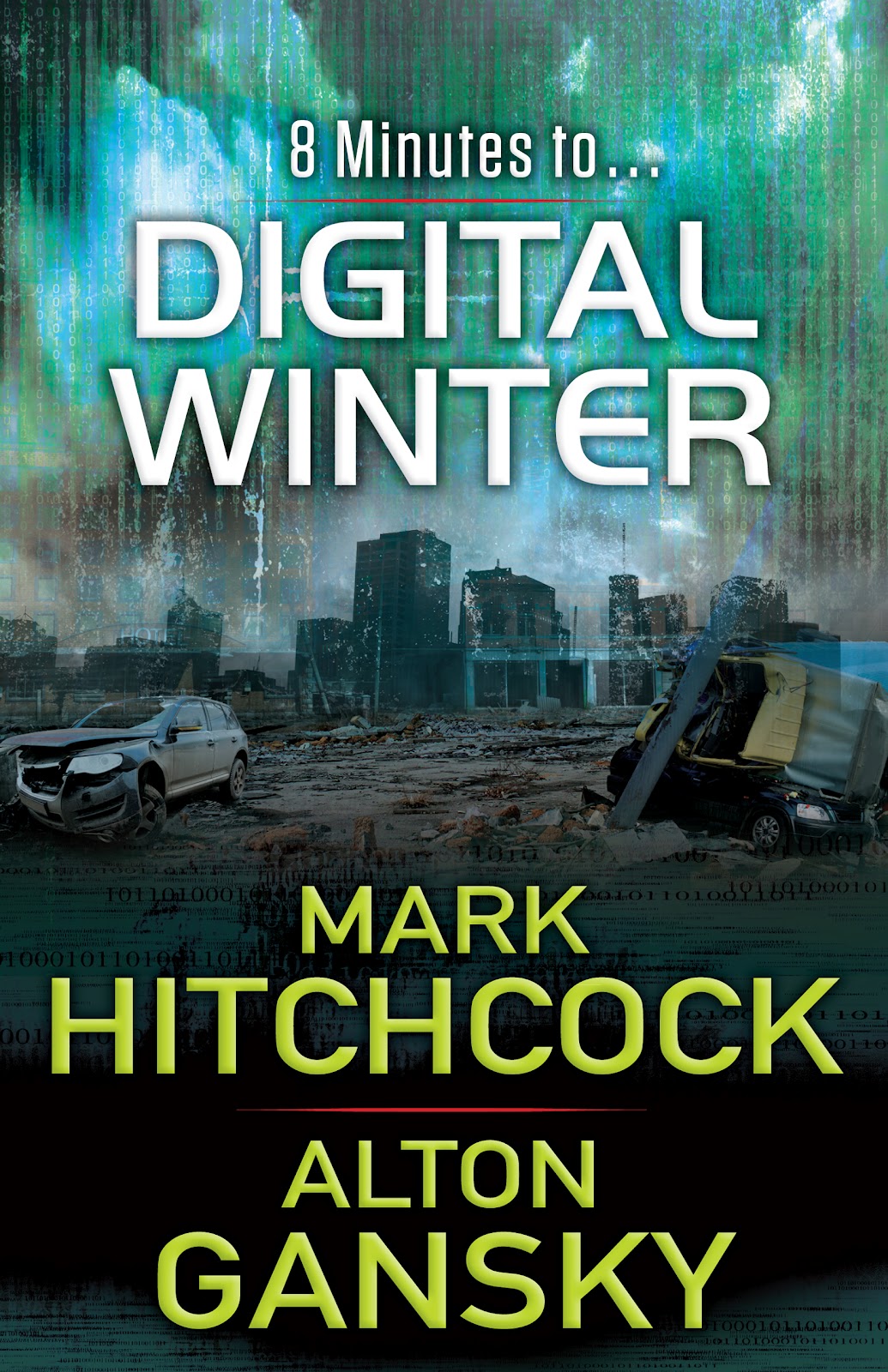
Prophecy expert Mark Hitchcock and novelist Alton Gansky provide a suspenseful and fast-moving story of life after a massive cyber attack. Surgeons find themselves operating without electricity. The military can’t use its computers… This gripping story of darkness and heroism highlights prophetic themes and the danger of a cyber attack.


Product Details:
List Price: $14.99
Paperback: 352 pages
Publisher: Harvest House Publishers
Language: English
ISBN-10: 0736949127
ISBN-13: 978-0736949125


My Thoughts:

Are you saying one of these worm thingies went out of control?”  (p.99)

This statement sums up about as much as I’m able to understand about computer viruses.  But after reading Digital Winter, not only do I have a better understanding of the imminent dangers posed by such things, I think it is entirely possible that it could be part of the end times scenario. In short, the story line in this book is very disturbing in its reality.  Disturbing, but not frightening, because when the time comes, I already know how the story ends.

For those who are like many characters in this story, those who dismiss God as their Creator, Savior and Lord, I can totally understand how they will be caught off-guard and be astounded when the world starts to implode.  In that sense, this story encourages me to be more evangelistic in my everyday life. That’s good writing folks!  And if you aren’t hungry for more when you reach the final chapters, then you must not enjoy the thrilling, unpredictable plot twists in Digital Winter

This is truly a great read that will keep you rapidly reading well into the night.  But when you reach the end….you will face tomorrow with a new sense of purpose.  Seriously!


AND NOW...THE FIRST CHAPTER:


Stanley Elton

January 20, 2014
Shadow, shadow on my right,
Shadow, shadow on my left,
Shadow, shadow everywhere,
Shadow has all the might.
Stanley Elton emerged from the bedroom at precisely 7:10 a.m., his favorite mug in his hand containing his favorite African blend of coffee. Truth was, he had seven favorite mugs, one for each day of the week. He had seven favorite blends of coffee as well, seven favorite dress shirts, seven chosen suits of varying shades of gray, and seven power ties.
T he morning sunlight had already pushed back some of the thick clouds that covered the parts of San Diego closest to the Pacific. His part of San Diego was called Coronado Island, although it wasn’t a true island. Situated on a stretch of land called the Strand, the small community rested on a jut of property that looked from the air like an arthritic thumb sticking into the blue waters.
Founded in 1860, the city of Coronado was home to the elite. North Island Naval Air Station took much of the prime real estate, but there was still plenty of room for retired admirals, CEOs, and entrepreneurs who made sudden wealth in the digital age. A stroll through the city streets sometimes allowed tourists a glimpse of a celebrity.
Stanley Elton was no celebrity or entrepreneur; he wasn’t a retired admiral or a man of old money. He was, however, the CEO of San Diego’s largest CPA firm, a company whose client list included scores of the top companies in the country. He was on a first-name basis with people often mentioned in the Wall Street Journal. For thirty years he worked for OPM Accounting. Most people assumed OPM stood for the founders of the firm, people who died a generation ago. It didn’t. Insiders knew OPM stood for Other People’s Money. A bit tongue in cheek, but it drew hearty laughs for the few who knew the joke.
“Nice day.” Stanley moved to the open kitchen and kissed his wife on the top of the ear.
“You know that gives me the shivers.” Royce Elton pulled away and tried to rub her ear on her shoulder, her hands busy flipping eggs and turning bacon. A pot next to the frying pan cooked down some oatmeal. Instant oatmeal wasn’t good enough for her son, Donny. At least he ate something close to healthy.
“My presence has always made you shiver.” Elton slurped his coffee.
“Shudder is more like it.” Her tone was playful.
“Shiver, shudder; potato, patahto.” He moved from the kitchen and took his usual spot at the floor-to-ceiling window overlooking the rolling Pacific. T he $3.5 million condo was on the top floor of one of the fifteen ten-story structures on the Strand. Built in the 1960s, the luxury buildings caused such a stir that a city ordinance was passed forbidding similar towering structures in Coronado. Too late and too little.
From the wide living room, Stanley could look to the left and see the Pacific Ocean or look right and see the calm waters of Glorietta Bay. “Water everywhere and not a drop to drink.”
“Good thing we have plumbing and coffee.” Royce dropped two pieces of bacon (well done) and two eggs (over hard) onto a scalloped-edged green plate. A moment later, she added two pieces of rye toast.
He stepped to the dining table. “Dining room” would be inaccurate. T he only real rooms in the open floor plan were the bathrooms and bedrooms. Royce set the plate on the glass top. She sat next to him, sipping a chocolate diet shake.
“Eating real food while watching you suck on that stuff fills me with guilt.” He stuck a piece of bacon in his mouth.
“You’re a man. You’re supposed to feel guilty. It goes with the Y chromosome.”
“T his is what I get for marrying a geneticist.”
“Brains are sexy.”
“Really? I hadn’t heard.”
Royce raised an eyebrow. “You know, I can poison your breakfast.”
“T hat’s why we have Rosa cook our other meals. Cuts down on your opportunity to cash in on the life insurance.” He cut one egg in half and scooped it into his mouth. Stanley didn’t like wasting time on trivial things like breakfast. “Busy day?”
“Usual classes at the university, and then I have about four hours in the lab. I’ll be late. I have to grade test papers after that. Rosa has something planned for you and Donny.”
“She’s as good a cook as she is a nurse.” Down went the second half of the egg.
“She’s a jewel. We should pay her more.”
It was Stanley’s turn to raise an eyebrow. “Really? She makes good money now.”
“I’m not sure it covers all she does. Dealing with Donny isn’t easy.”
Stanley contemplated the comment while gnawing on the bacon. “What do you mean? He sits in his room and doesn’t cause any trouble. He’s as passive as someone with his condition can be.”
Royce frowned. She hated it when Stanley referred to Donny’s challenges as his condition.
“Sorry,” he said. “You know what I mean. Other people like him can be high maintenance.”
Another frown. “He requires a lot of care, Stan. You know that.”
“Of course. I do my share.”
She touched his arm. “I know, dear. I didn’t mean that. You do more than any other father would. You provide an income that allows us to get all the help we need. My professor’s salary wouldn’t pay for one room in this place. I’m just saying we should reward Rosa. She’s been with us since Donny was ten. T hat’s twelve years.”
“She’s a trooper. Did you have something in mind?”
“I thought of a paid vacation, but I don’t think she’d leave Donny for more than a few days. She’s so devoted to him. I know that her car is getting a little long in the tooth. She had to take it into the shop. Cost her a pretty bundle to get the transmission fixed.”
“You want to pay for the repairs?”
“No, I want to buy her a car.”
Stanley lowered his fork. “You’re kidding, right?” He could see she wasn’t. “You mean like a Porsche or Ferrari or—”
“Of course not. I was thinking of a Prius or some other hybrid. It would save her some gas money.”
Stanley furrowed his brow, narrowed his eyes, and clinched his jaw, but he couldn’t maintain the pretense. He had never been angry at his wife and couldn’t imagine starting now. T he forced frown gave way to the upward pressure of a smile.
“You’re working me, aren’t you?”
“Yep.”
“Okay, but it’s going to cost you another cup of coffee. I’ll let you make the arrangements. Take the money from the house account.” He paused. “We are talking just one car, right?”
“For now.” She rose, kissed him on the forehead, and took his cup to refill it. “Speaking of Rosa, she said something yesterday that seemed…”
“What?”
“I don’t know what word to use. Unexpected.” She filled the cup and returned to the table. “She said Donny spoke.”
“Spoke? You mean more than one word?”
“She meant sentences.”
“You’re kidding. I’ve never heard him link words together. I thought it was beyond his ability.”
“We don’t know that.” Royce the geneticist was talking now. “His condition is a mystery. T here are only a handful of savants in the world. We don’t know what goes on in his brain.”
“What did he say?”
“She told me she couldn’t make out all the words. He stopped when she entered the room. Something about shadows.”
“Maybe she was hearing something from one of his computers.”
“Maybe, but she didn’t think so.”
Stanley checked his watch. “Why didn’t you tell me this last night?”
“Um, because you didn’t come home until nearly midnight and you were half asleep.”
“Oh, yeah.” He rose. “T hanks for breakfast. Good as Rosa is, food cooked by my wife always tastes better.”
“I manipulate the alleles in the eggs.”
“T hat’s more science talk, isn’t it?”
“You going to say goodbye to him?”
“Just like every day for twenty-two years.”
“T hanks.”
Stanley started the most difficult task of his day. He loved his son, but he would rather face off against a bunch of IRS attorneys than turn the doorknob to his boy’s bedroom.
As his hand touched the brass knob, he heard a voice from the other side of the door:
Shadow, shadow on my right,
Shadow, shadow on my left,
Shadow, shadow everywhere,
Shadow has all the might.
....
Donny Elton sat in his chair as he did every hour he wasn’t sleeping. T he chair was an expensive, well-padded iBOT designed by inventor Dean Kamen. It was powered and could raise Donny to the eye level of any adult not playing in the NBA. A series of gyros and a robust computer program enabled it to climb stairs without tipping. T he invention had been a boon to wheelchair-bound consumers.
But Donny wasn’t bound to the wheelchair. He could walk if he wanted, jump if he desired, and even sprint if he had a mind to, but he never did. At least that was what the doctors said. Under heavy sedation, Donny had endured MRIs, CAT scans, X-rays, muscle conductivity studies, and other medical tests. All came back negative.
“T he problem isn’t with this body,” the doctors said. “T he problem is in his mind. He doesn’t want to walk.” T hat had been the end of their assessment. No one could offer any ideas of how to make a healthy twenty-two-year-old who was monosyllabic on his best day and mute on his worst and who possessed an IQ above 200 do what he didn’t want to do. “You simply cannot make a man walk if he doesn’t want to.” T hey had been united in that assessment.
Stanley, in the few quiet moments he allowed himself, wondered why his son refused to walk or engage with humanity. Yes, his savant condition was probably due to autism, but research had yet to come to a consensus on that.
Stanley stood in the open door with a bowl of hot oatmeal in one hand and wondered if he had heard what he thought he heard.
“Hey, buddy. Mom whipped up some oatmeal for you.” He moved to the long desk that took up all of one wall in the place they called Stanley’s bedroom. It looked more like a NASA control center than a place to sleep. A series of four 27-inch monitors lined the table, and two computer towers sat nearby. T hey were never turned off. More than once, Stanley had awakened in the night to hear Donny’s fingers tapping on the keyboard.
“Oatmeal. Food. Oatmeal. Good.”
Stanley set the bowl and spoon on an unoccupied spot of the table. “Whatcha working on, pal?”
“Oatmeal. Good.”
Stanley was thankful Donny could feed himself. He needed help dressing and using the bathroom, but at least he could manage to put a spoon in his mouth or hold a sandwich. Small blessings.
T he large window of the bedroom overlooked the Pacific side of the Strand. T he thinning cloud cover allowed the morning sun to paint sparkles on the gentle swells and surf. A short distance from the shore, surfers waited for the ocean to offer more waves. Although Stanley couldn’t see them from this window, he knew that new Navy SEALs were training there. Such was Coronado: home to the wealthy, a mecca for sun worshippers, a training ground for the Navy, and a magnet for tourists.
Donny knew none of this. Stanley doubted his son had ever noticed the beauty outside his window, the kind of view that made the 1700-square-foot, three-bedroom, three-bath condo worth $3.5 million. T he only things Donny seemed to notice were on the computer monitors. Stanley doubted the young man even knew him. T he last thought brought pain, as it did a dozen times every day.
Line upon line of code filled the monitors. For a few moments, Stanley considered having a programmer look at it, but he dismissed the idea. What difference would it make?
“I’m headed to work, son. I’ll be home late again, but I’ll look in on you. Mom will be here until Rosa arrives.”
“Rosa. Oatmeal. Good.” Donny took a bite of the pasty meal.
Stanley ran his fingers through his son’s hair. He loved the boy even if he had never caught a baseball or watched a football game. “Take it easy, champ.”
“Bye. Later. Oatmeal.”
Stanley turned when something appeared in the corner of his eye—something dark, indistinct. He snapped his head around but saw nothing.
Closing the door, Stanley paused and tried to push back the gloom that draped his mind. T hen he heard Donny’s voice again.
Shadow, shadow on my right,
Shadow, shadow on my left,
Shadow, shadow everywhere,
Shadow has all the might.


Monday, August 20, 2012

The Face of Heaven by Murray Pura - Reviewed


About the Book: (from Harvest House)

Following on the heels of The Wings of Morning, the first book in Murray Pura’s Snapshots in History series, comes this compelling saga of the Civil War.
In April 1861, Lyndel Keim discovers two runaway slaves in her family’s barn. When the men are captured and returned to their plantation, Lyndel and her young Amish beau, Nathaniel King, find themselves at odds with their pacifist Amish colony
Nathaniel enlists in what will become the famous Iron Brigade of the Union Army. Lyndel enters the fray as a Brigade nurse on the battlefield, sticking close to Nathaniel as they both witness the horrors of war—including the battles at Chancellorsville, Fredericksburg, and Antietam. Despite the pair’s heroic sacrifices, the Amish only see that Lyndel and Nathaniel have become part of the war effort, and both are banished.
And a severe battle wound at Gettysburg threatens Nathaniel’s life. Lyndel must call upon her faith in God to endure the savage conflict and to face its painful aftermath, not knowing if Nathaniel is alive or dead. Will the momentous battle change her life forever, just as it will change the course of the war and the history of her country?
The Face of Heaven is a dramatic story that will release on the 150th anniversary of the historic battle of Antietam, September, 1862.
My Thoughts:
“The one thing that transcends all this folly and carnage is the Spirit of the Lord.”  (p. 250)

This is a powerful story of the awesome transcendence of Christ’s mercy and grace in the midst of one of the most difficult times in American History.  Slavery became the war cry that rallied brother against brother in the civil war.  Others fought to preserve the United States of America from splitting apart and becoming two separate countries.  And in the midst of that awful time in history, the Amish people were also faced with divisive decisions.  The Face of Heaven explores all of these facets of history and story, and when all is said and done, it is the Spirit of the Lord alone that does indeed transcend the carnage of body, spirit, relationship and soul.

You will cheer, you will weep, you will rejoice with the characters in this story.  There are relationships that are born between the characters and significant historical persons that really make the story special!  I won’t say much about this, because I don’t want to take anything from your discovery! The choices that Lyndel and Nathaniel make are so very difficult! Yet the relationship that blossoms between them truly weathers every storm.  There are times when survival is very uncertain most certainly, but the outcome of each circumstance is both realistic and natural in its progression.
The Face of Heaven hides nothing of the horror of this Civil War.  Nothing! There are times you may want to turn away and weep.  Yours won’t be the first tears to fall, believe me!  This feels like an epic story of truth to me, and I am very happy to recommend it to you! 

About the Author:
Murray Pura earned his Master of Divinity degree from Acadia University in Wolfville, Nova Scotia, and his ThM degree in theology and interdisciplinary studies from Regent College in Vancouver, British Columbia. For more than 25 years, in addition to his writing, he has pastored churches in Nova Scotia, British Columbia, and Alberta. Murray’s writings have been shortlisted for the Dartmouth Book Award, the John Spencer Hill Literary Award, the Paraclete Fiction Award, and Toronto's Kobzar Literary Award. His novels for Harvest House include Face of Heaven and The Wings of Morning. Murray pastors and writes in southern Alberta near the Rocky Mountains. He and his wife, Linda, have a son and a daughter.

Sunday, August 19, 2012

Dying to Read by Lorena McCourtney - REVIEWED


About the Book: (from Revell)
All she wanted was a paycheck. What she got was a murder.

Cate Kinkaid's life is . . . well, frankly it's floundering. Her social life, her career, her haircut--they're all a mess. Unemployed, she jumps at the chance to work for her PI uncle, even though she has no experience and no instincts. After all, she is just dabbling in the world of private investigating until she can find a "real" job.

All she has to do for her first assignment is determine that a particular woman lives at a particular address. Simple, right? But when she reaches the dark Victorian house, she runs into an hungry horde of gray-haired mystery readers and a dead body. This routine PI job is turning out to be anything but simple. Is Cate in over her head?

My Thoughts:


“I want to do that.  Whatever it takes.”  (p. 311)
Cate Kinkaid has a tenacity that draws me to her character.  Her perceived failures in life ultimately bring her to a place where she is doing something she loves working  with people she loves.  Isn’t that just like God?  Always working in our lives, in spite of our choices, and bringing us to a place that is tailor made for our talents and His purposes?  Well, in my opinion, that’s what happens to Cate in Lorena McCourtney’s  new novel, Dying to Read.
This is a cozy mystery that contains a cast of characters that have many quirks and quandaries.  Cate seems to take the lead in many blunders, but everyone in the story sort of stumbles onto and into situations that throw them a curve ball.  I think that’s what I admire about McCourtney’s writing – nothing contrived about the way her characters behave.  Whether they are a good guy or bad guy, they all behave in a believable manner – quirky though it may be.
Anyway, you will love, be annoyed by, despise, and cheer for the characters in this series!  Cate begins her journey just trying to locate a girl for her uncle.  A few dead bodies later, attempts are being made on Cate’s life!  And by the time you reach the end of the story, like Cate, you wonder if she will survive her chosen profession!
So buckle up for a crazy, unpredictable ride folks!  The Cate Kincaid Files promises to be a wonderful series!
About the Author:
Lorena McCourtney is the award-winning author of dozens of novels, including Invisible (which won the Daphne du Maurier Award from Romance Writers of America), In Plain Sight, On the Run, and Stranded. She resides in Oregon.

Friday, August 17, 2012

Globequake by Wallace Henley


It is time for a FIRST Wild Card Tour book review! If you wish to join the FIRST blog alliance, just click the button. We are a group of reviewers who tour Christian books. A Wild Card post includes a brief bio of the author and a full chapter from each book toured. The reason it is called a FIRST Wild Card Tour is that you never know if the book will be fiction, non~fiction, for young, or for old...or for somewhere in between! Enjoy your free peek into the book!

You never know when I might play a wild card on you!


Today's Wild Card author is:


and the book:

Thomas Nelson (July 10, 2012)

***Special thanks to Rick Roberson of The B&B Media Group, Inc. for sending me a review copy.***

ABOUT THE AUTHOR:

Award winning journalist and former White House aide during the Nixon administration, Wallace Henley has traveled the world as a speaker and writer, authored more than a dozen books, served as a congressional chief of staff and leadership consultant, and has worked in over 20 countries, all the while gaining a keener grasp of scripture and a deeper understanding of human nature. Today, as he has for the past 11 years, Henley serves as pastor in the 59,000-member Second Baptist Church of Houston, led by Ed Young. He is also a regular columnist for Christian Post. When not traveling, he and his wife of over 50 years, Irene, divide their time between their home in the Houston area and their small ranch outside of Brenham. The couple has a grown son and daughter and eight grandchildren.


Visit the author's website.

SHORT BOOK DESCRIPTION:

2011 was a year of disturbance. Tunisia erupted in violence in January, after a street vendor set himself on fire, and unrest spread across the Middle East in a wave of toppled dictators and violent revolutionaries. March saw tsunamis sweep across Japan, leaving a nation teetering on the edge of nuclear catastrophe. Rioters stormed through the streets of London in August, burning cars and looting stores. Vicious partisan attacks left the American government deadlocked as unemployment stayed high, families desperately tried to find work, and disillusioned protestors occupied public parks from New York to Oakland.

The very underpinnings of the world, the tectonic plates of existence, seem to be shifting and sliding under the feet of every person, and in this time of crisis, author Wallace Henley provides a blueprint for surviving the changes in his new book Globequake: Living in the Unshakeable Kingdom While the World Falls Apart. Henley argues that we are seeing a shift taking place in what he calls the "six core spheres of society" - Person, Church, Family, Education, Government, and Business. In Globequake, he extensively and exhaustively details the transformations crossing all parts of daily life, but the book is more than a list of the changes in the world, it is ultimately a focus on the change that people can have in their hearts.


Product Details:
List Price: $16.99
Paperback: 288 pages
Publisher: Thomas Nelson
Language: English
ISBN-10: 1595555013
ISBN-13: 978-1595555014


AND NOW...THE FIRST CHAPTER:


Chapter 1—The Globequake and the ‘New Normal’
The shaking is here to stay

“Our political leaders are lying to us. All commodities are skyrocketing, and have been for months. It’s not just oil, but metals for manufacturing, labor costs, and everything else necessary to do business. It’s beginning to kill us, and there must be major redefinition!”
The words erupted suddenly from the executive, like magma building for centuries in the throat of a volcano. I could feel the throbbing anxiety in the usually solid business leader. I knew he had survived—even thrived—through several upheavals in his long career. But somehow it was different this time.
As a pastor I had heard the desperation and fear on the voices of many people in all stages and spheres of life as they sought comfort and hope. I’ve been listening to people pour out their heartbreak and worries for 40 years, but, as in the case of the businessman, the tension has reached a new pitch.
Emotionally, multitudes now are like people in a scene caught by a camera as an earthquake of record-breaking proportions struck a Japanese city in early 2011. Men and women working in a skyscraper were filmed dashing out of the tall building. They had to dodge the steel and stone crashing down from the swaying highrise. Their heads pivoted and eyes looked desperately as they wondered: Is there safety anywhere?
It appears people everywhere seek security midst the instability of a world gone wild. Our planet is in a state of upheaval, blasted with worldwide turbulence.
It’s a “Globequake.”
Individuals across the globe sense something big is shaping. Is it global collapse? Fiery wars along the civilizational “fault lines” Samuel Huntington wrote about in the 1990s? Worldwide depression? Mass starvation? Ecological chaos? The end of the world?
People everywhere are asking,
           What’s going on?
           What can I do?
Down deep in all this roiling turbulence people are trying to go about their lives, maintain solid marriages, raise and educate their children, and do their jobs.
All they know is gut-anxiety.
It’s as if the tectonic plates of society and culture are being torn apart and reshaped right under our feet. “The social threat to the American way of life” is “dire,” writes Rich Lowry.  Voices in many nations around the world would say the same for their societies.

Good news
The good news is that behind the gut-wrenching uncertainties about the future are wonderful, strong certainties, given by the Lord of history Himself.  In this book we will discover answers to the troubling questions through solid biblical truth that can be applied to bring stability to us and our institutions. What you will read here unites orthodoxy (right belief) with orthopraxy (right practice) based on foundational truth on which people can ground their lives when the continents are shifting at what seems light-speed.
In the Globequake turmoil we can either react with negative indignation, or we can proact with positive insights. In the pages ahead you will discover the positive, exciting, stabilizing truths and principles that provide the insights by which people can be safe, sane, and stable midst worldwide upheaval, and be inspired with hope.
We are living through the spiritual, social, moral, philosophical, economic, political, and personal equivalent of the ancient geological tectonic shifts that brought upheaval and reshaping of vast landmasses. Like those redefining physical movements, what we are experiencing now is worldwide. Unlike the tectonic shifts of antiquity, in which the drift was inches a century, the changes rumbling throughout our “worlds” seem to be zipping at miles a second, with us riding on top!
The Psalmist posed the question in the hearts and on the lips of multitudes today:
If the foundations are destroyed,
What can the righteous do?"
(Psalm 11:3)

Spinning down the ‘ringing grooves of change’
Change, by definition, is initially a departure from a normative condition. After awhile the new situation becomes the norm, until change sweeps it away and drops something else in its place. However, under the Globequake conditions in which we now live, rapid change and the upheavals it produces is the “new normal.” Tennyson wrote, “Let the great world spin forever down the ringing grooves of change.” It appears he got his wish.
“The more things change the more they stay the same,” said 19th century French writer Jean-Baptiste Alphonse Karr. However, the aphorism has been turned on its head in the Globequake age, and now says, “The more things stay the same the more they change.” Victor David Hanson writes, “the natural order of the world is chaos, not calm.”  Will Durant, writing in a more optimistic age, thought humans could dominate chaos by “mind and purpose.”  But far from dominating chaos, humanity seems to be falling into “a systemic rise in worldwide unrest,” writes Peter Apps, “political risk correspondent” for Reuters, the international news agency.
It’s not just geopolitical systems trembling all the way to their foundations, but everything around us. The face of the world is being reshaped before our eyes, with new power centers emerging like islands suddenly leaping from the sea-bottom, thrust upward by volcanic fury. “We are in the midst of a phase of history in which nations will be redefined and their futures fundamentally altered,” said media mogul Rupert Murdoch, in an internal memorandum to his staff.
In my lifetime I have seen America and the West move through three eras:
           The Atlas Era, when the Western Alliance seemed to hold the world on its shoulders, leading the resistance to Nazi, and then Communist threats to global freedom
           The Bacchus Era, when, under the priesthood of people like Hugh Hefner and Timothy Leary, cultural elites, weary from shouldering the world, let themselves go, did their own thing, and retreated into the body and its cravings, taking masses with them
           The Narcissus Era, in which every wrinkle is a crevasse begging for cosmetic surgery, where every emotional flitter is a tornadic psychic upheaval, and every Twittered and Facebook-inscribed self-narrative is epic literature.
Under the Globequake, Western civilization has been dislodged from strong biblical moorings, and shifted into nominal Christianity, then to the minimizing of Judeo-Christian influence, then to anti-biblical materialism, then into vague “spirituality” that tries to find anchorage in the sandy bottom of ancient paganism, and at last into a spiritual void Islam and a host of other religious and philosophical systems are eager to fill. The Western nations have fallen into the deep rifts of existentialism (“the only meaning is in the experience of the ‘now’”), nihilism (“there is no purpose or meaning in anything”), and hedonism (“since there’s no purpose or meaning in anything, make life one vast party, then die”).
We have arrived at the stage of history Peter Drucker must have had in mind when he wrote on the eve of the 21st century,
"Everybody has accepted by now that change is unavoidable. But that still implies that change is like death and taxes — it should be postponed as long as possible and no change would be vastly preferable. But in a period of upheaval, such as the one we are living in, change is the norm."
What makes the upheavals of our time different from the tremors and redefinitions of other eras? Can we really claim the contemporary turbulence is any more intense than that of any other? We will explore these questions in detail in chapters to come. However, here are three ways in which the upheavals we now experience differ from those of other historic ages.
Scope
For centuries, people have been talking about “changing the world.” In previous eras, the “world” they dreamed of changing was at best regional in scope. Hannibal could conquer only that small bit of the planet he could cover with his elephants. Genghis Khan may have fancied himself a world-conqueror, but vast numbers of people living in his age were beyond the reach of his sword. Now, for the first time in history, it’s possible to impact the whole world with change, which, in the Globequake era, is becoming viral and universal.
The alterations of the Globequake age are making borders irrelevant. In previous periods, attacking armies could be blocked at well-defended boundaries between nations, but electronic invasions render normal lines of defense useless and even meaningless. Regimes that don’t want their societies to participate in the change can only try to block powerful marauders like Google, Facebook, Twitter, and other information systems, but they cannot prevent the leakage of news and opinion into their societies, and the changes that inevitably occur.
Many have assumed the Internet would open closed nations to democracy. But there’s just as much concern authoritarian regimes are learning to use the Web to manipulate their populations through such strategies as propaganda-spreading blogs, and to spy on opposition groups. The scope of change in today’s world can be as ominous as it is promising. Powerful groups and individuals can spin the currents of change toward their own interests, and they can do it worldwide—for the first time in history.
Some even see a future in which computers become so dominant they take over the world. Professor Stephen Hawking has called for genetic engineering to develop human intelligence to outpace the growth of computer intelligence. “In contrast with our intellect, computers double their performance every 18 months,” he told Focus, a German magazine. “So the danger is real they could develop intelligence and take over the world.”
Bill Joy, co-founder of Sun Microsystems, expressed a similar concern about the scope of change possibly looming for the world’s future. By 2030, he says, engineers may be building machines a million times more powerful than today’s computers. “I may be working to create tools which will enable the construction of the technology that may replace our species,” worries Joy. 
The scope of the new normal of change is not merely electronic. In the industrialized nations especially, there is scarcely any institution not impacted by what has become a continuum of change. Revered establishments that have preserved and propagated belief and value systems have toppled into the rifts opened by the Globequakes.
The scope is so broad it seems no one can escape the changes hurtling toward us in the Globequake age. Just about the time we adjust to one set of transitions, we are assaulted with more changes zipping at us faster than we can assimilate them.
Velocity
The accumulation of information is the fastest increasing quantity in the world.  Researchers at the University of California—Berkeley, examined the “total production of all information channels in the world for two different years, 2000 and 2003.”  In 2000, the total production of new information in a 12-month period amounted to 37,000 times the information housed in the Library of Congress. By 2003, the accumulation of information was growing by 66 percent per year. The total amount of scientific knowledge has been doubling every 15 years since 1900.
Information alters existing realities, and also creates new phenomena. The velocity of information therefore accelerates change. The Industrial Age shows there are certain periods of megaleaps, when technologies, systems, and processes morph seemingly overnight into radically new forms. An 18th century balloon and the Wright Brothers’ airplane shared the goal of enabling humans to fly, but the plane was a leap into a new category.
Information is a primary catalyst of change. No previous historic period has experienced the velocity of the increase of information; therefore, the contemporary period is unique—up to this point of history. This is why Globequake-level change is the new normal.
What about the future? Clearly, if the velocity builds with its own momentum, the eras ahead will be marked by even more radical change. This raises a question of apocalyptic proportions: At what point does the velocity overwhelm the “vehicle”? An airplane, for example, has a maximum speed. Go beyond that and structural failure occurs. Systems break down. Already, as the Berkeley study found, “the information about and from a process will grow faster than the process itself… and so as we progress, information will grow faster than whatever else is being produced.”
How will we contain it all? Followers of John the Baptist asked Jesus one day, "Why do we and the Pharisees fast, but Your disciples do not fast?" (Matthew 9:14 ) Jesus’ answer is as relevant today as 20 centuries ago:
“… no one puts a patch of unshrunk cloth on an old garment; for the patch pulls away from the garment, and a worse tear results.  Nor do people put new wine into old wineskins; otherwise the wineskins burst, and the wine pours out and the wineskins are ruined; but they put new wine into fresh wineskins, and both are preserved." (Matthew 9:16-17)
The Gospel proclaimed by Jesus was truth so dynamic, so vibrant with life new structures were needed to convey it across society and history. The cry of the present Globequake age is for new “wineskins,” new structures that can cope with the information coming at lightspeed—literally. Sadly, having rejected the way of Jesus, the old religion of humanism can’t handle the flood either, and its leaders work their fingers raw trying to piece together new structures.
As we will see in the chapters ahead, once again the truth about Jesus and His Kingdom is the “new wine” that will bring strength and vitality to the world in upheaval. The structures of society must be renewed—they must become “new wineskins”—to receive the powerful principles that give them enduring calm and stability as they are being squeezed and torn by the Globequake. As the velocity of information builds, the accumulation of energy begins to impact the face of entire civilizations. Hardly any institution escapes the resulting magnitude of change.
Magnitude
The ancient tectonic plate movements in earth’s geology and geography were immense in magnitude, altering the face of the whole planet. The changes now underway in the spiritual, social, political, economic, ethical, and philosophical “continents” of the world are just as huge. The upheaval that is the new norm in the present is redrawing the face of the world!
According to tectonic shift theory, in the earth’s early history there was one vast supercontinent, Pangea. Upheavals deep in the planet caused the plates on which the landmass rested to split, dividing massive chunks from one another, and setting them adrift on the planet’s surface.
In a sense, this is what is happening to the spiritual, intellectual, and socio-political systems of the world. There was once consensus holding whole civilizations together. For example, scholars have noted the similarities between the Ten Commandments and other law codes of nations surrounding the Hebrews. The Ten Commandments were revealed to Moses by God Himself, in an act theologians call “special revelation.” However, God’s “general revelation” is written instinctively in every human being (Romans 2:15), so it’s no surprise there’s a certain consensus among humans regarding murder, theft, adultery, and other moral issues on a near-global scale.
Globequake forces, however, shatter the consensus. Moral relativism has devastated Western civilization. There is no longer a firm, inviolable consensus around a core belief system. When the consensus is destroyed, the Pangea of human belief and behavior is ripped apart. The world fragments into the chaos of Israel in the time leading up to the Judges, when every person “did what was right in his own eyes.” (Judges 17:6)
The fragmentation in the consensus about God has had an impact of great magnitude on many cultures. Under Globequake conditions, God has first been pushed off to the sidelines of the public square, and, in the thought of many elites, shoved out of sight totally.
The magnitude of this act is immense in its destructive force. G.K. Chesterton wrote, “in the act of destroying the idea of Divine authority we have largely destroyed the idea of that human authority by which we do (an arithmetic) sum.”  The destructive forces at the highest levels of magnitude radiate downward, to the most detailed concerns of life. With the loss of reverence for God comes a loss of reverence for His creation—beginning with human life. Here the magnitude of the upheaval reaches truly tragic proportions, resulting, for example, in the abortion culture, and the deaths of tens of millions of unborn babies.
Three impacts on people
The scope, velocity, and magnitude of the changes wrought by the Globequake impact us in three major ways.
Insecurity
People have many reasons to feel insecure in the Globequake age. They worry about their marriages and other relationships, job security, caring for their aging parents, and their own retirement, as well as a secure future for their children and grandchildren. On the national and world scale there’s concern about the availability of oil and other energy resources. Many worry about the declining quality of leadership in a period when churches, families, schools, government institutions, and businesses need the best.
And then there’s always the weather. One chunk of the population fears climate change portends serious injury to the planet’s ecosystem, which they believe to be fragile. Another hefty demographic worries those who agonize over global warming and other environmental changes are laying the framework for more government control of industrial and commercial development, and the reduction of personal freedoms.
Many people are haunted by vague, unidentifiable anxiety, manufactured within their own turbulent souls. We have managed to create an entire culture of insecurity. Both the real and imagined threats of the Globequake age drive us deeply into ourselves in the effort to fend off the gremlins of fear and anxiety. The outcome is what we experience presently: self-absorption resulting in what Harvard sociologist Pitirim Sorokin called the “sensate” stage of a culture, when feelings and emotions govern. The more we view the world through the lens of our own emotions, the greater loom the threats to our security.
Christopher Orlet writes, “an overdose of self-esteem and self-promoting technology have combined to create a perfect storm of narcissism.”  The more narcissistic we become the more insecure we are, worrying about the ripples that will destroy the image we stare at relentlessly in the increasingly troubled waters of our world. Thus, there is a vicious cycle in which insecurity leads to a passion for self-preservation, which rushes into self-absorption, which results in more insecurity.
Under such pressure, the psyche begins to crumble. In the Globequake age, the heavy lifting of which only the spirit is capable has been cast upon the flimsy soul. The Greek word translated “soul” in the New Testament is psuche, from which we get “psyche” and a whole family of terms. Insecurity is felt most acutely in the soul, where we think and feel emotionally. If the condition persists, it affects the body with physical symptoms, and drives people to the drugs and medications characteristic of our times. The best the weary, overtaxed soul can do is crank out counterfeit spirituality leading only to more disappointments, uncertainties and desperate quests for security.
If we live in a state of insecurity long enough, after awhile we drift into insanity.
Insanity
Insanity is at epidemic proportions. That was the conclusion of E. Fuller Torrey and Judy Miller in their 2002 book, The Invisible Plague.  From 1955 into the 21st century, many medications had become available, but the number of people diagnosed with mental illness had increased six-fold!
It’s not just individuals, but whole nations can also lose touch with their identity and history. What is the insanity that causes entire cultures to lose their minds and dive into the spiritual, moral, and intellectual fissures gouged by the Globequake?
 “Identity is an individual’s or group’s sense of self,” wrote Samuel P. Huntington, in Who Are We?, a study of contemporary America’s identity crisis.  Identity is important, he adds, because it shapes our behavior. So people who rip apart high values covering them, their families and nations, suffer from sheer insanity. Their destructive behavior shows a loss of their own identity.
Insanity is “reason used without root, or reason in the void,” wrote G.K. Chesterton.  “The man who begins to think without the proper first principles goes mad; he begins to think at the wrong end.” Cultural, societal, and national insanity occurs when people destroy their roots and forget their first principles. The Globequake tears out the root-system and brings down the edifice of first principles. That’s why whole societies lapse into insanity and lose their stability.
Instability
One day in 1973 the reality of the world’s instability flamed to searing focus in my mind. I had grown up and spent much of my young adulthood in a nation where you griped if you had to pay 38-cents for a gallon of gas. But that morning as I pulled up to a pump, I was stunned when I saw the price for a gallon of gasoline had rocketed to 58-cents. While I slept something drastic had been afoot in the world. The tremors then were mild—we would eagerly pay 58-cents for a gallon of gas today—but they portended greater instability and upheaval to come.
In a much larger way, the devastating destabilization of the Globequake is its impact on the foundations on which all strength and order rest. So, in response to the Psalmist’s rhetorical question: there is much the righteous can do in the midst of foundations crumbling under Globequake upheaval. David gives us the foundational principle as, through the inspiration of the Holy Spirit, he begins answering his own question. The central fact we must keep in focus when the foundations are quivering beneath us is recorded in verse 4: “The LORD is in His holy temple; the LORD'S  throne is in heaven…” Here is stability and confidence!
In a later chapter we will explore the unshakeable Kingdom. Its strength is in the Person enthroned in the “holy temple.” He is immoveable and unchangeable, not because He doesn’t like change, but because He doesn’t need it. At the core of all reality, and in the midst of the most catastrophic upheavals, there is One who is perfect and complete, dwelling in a temple no magnitude of quake can topple, on a throne from which He cannot be removed by any force or power.
There are three essential foundations on which the tremors focus their fury. The first is God Himself, the second is the foundation of truth, and the third, the foundation of humanity. The absolute and objective reality of God cannot be destroyed, but self-created human perceptions of God can be rattled to the very foundations. Since God and truth are inseparable, ultimate truth cannot be altered, but under intense tremors can be distorted and confused. Because the human is created in the image of God, the foundational nature of humanity cannot be obliterated, but it can be twisted. If these foundations are destroyed in the subjective understanding and experience of human beings, what can the people do who seek to hold to God’s holiness and purity midst the turbulence of our age? Plenty, as we will see in the pages ahead.
‘Things will settle down’
“Things will settle down,” my mother used to tell me. Pearl Harbor and America’s entry into the world war came two days after my birth in 1941. My childhood was full of the global conflagration and its aftermath. Ten years later, divorce blitzed our home, and our family experienced personal upheaval. When I was a teenager and young adult, the headlines were obsessed with the inevitably of global nuclear war.
Always my mother would say, “Things will settle down.”
She’s been gone a long time, but now I understand why she remained stable and hopeful, no matter how intense the quakes that rumbled through her life and world, and how she was able to steady our household.
Mother was the youngest of nine children. She and her widowed mom were left on a barren farm as my mother’s older siblings went to the big city to try to find jobs to support themselves, their mother and little sister. There were times when my mom, at age six, had to milk the neighbor’s cow so she and her own mother could survive. Later in life, my mom rode out the heart-rending turbulence of domestic violence and the divorce that destroyed her 18-year marriage. She was faced with the challenge of raising and educating my sister and me. But she couldn’t be knocked down. She kept standing, no matter what. That’s why I believed her when she said things would “settle down.”
Now I see my mother didn’t mean the tremors would stop. She knew they were the norm. One of the reasons my mother knew things would “settle down” was because she was old enough to see a big swath of history. She believed God was in charge of every moment. She knew “all things work together for good” for those called by God and set apart for His purposes—even if it took decades (See Romans 8:28-39). She had an instinctive sense of how time works, and that formed her understanding of her narrow slice of history and an individual’s experience within it.
Finally I figured it out. She wasn’t telling me the external world would “settle down,” because the upheavals were the norm. Rather, my mother was saying I would “settle down” in the midst of the shaking by positioning myself on sold biblical truth, just as she had done.
“What can the righteous do?” For one thing, we must examine and incorporate into our worldview the Bible’s revelation about how time functions, and allow that truth to shape our perspective about the Globequake. As my mother demonstrated, you don’t have to be an Albert Einstein or Stephen Hawking to get it!